
Cisco Packet Tracer VoIP
Describe a VoIP lab — Call Manager Express, IP phones, dial-peers — and NetPilot builds a working .pkt in your browser.
See It in Action
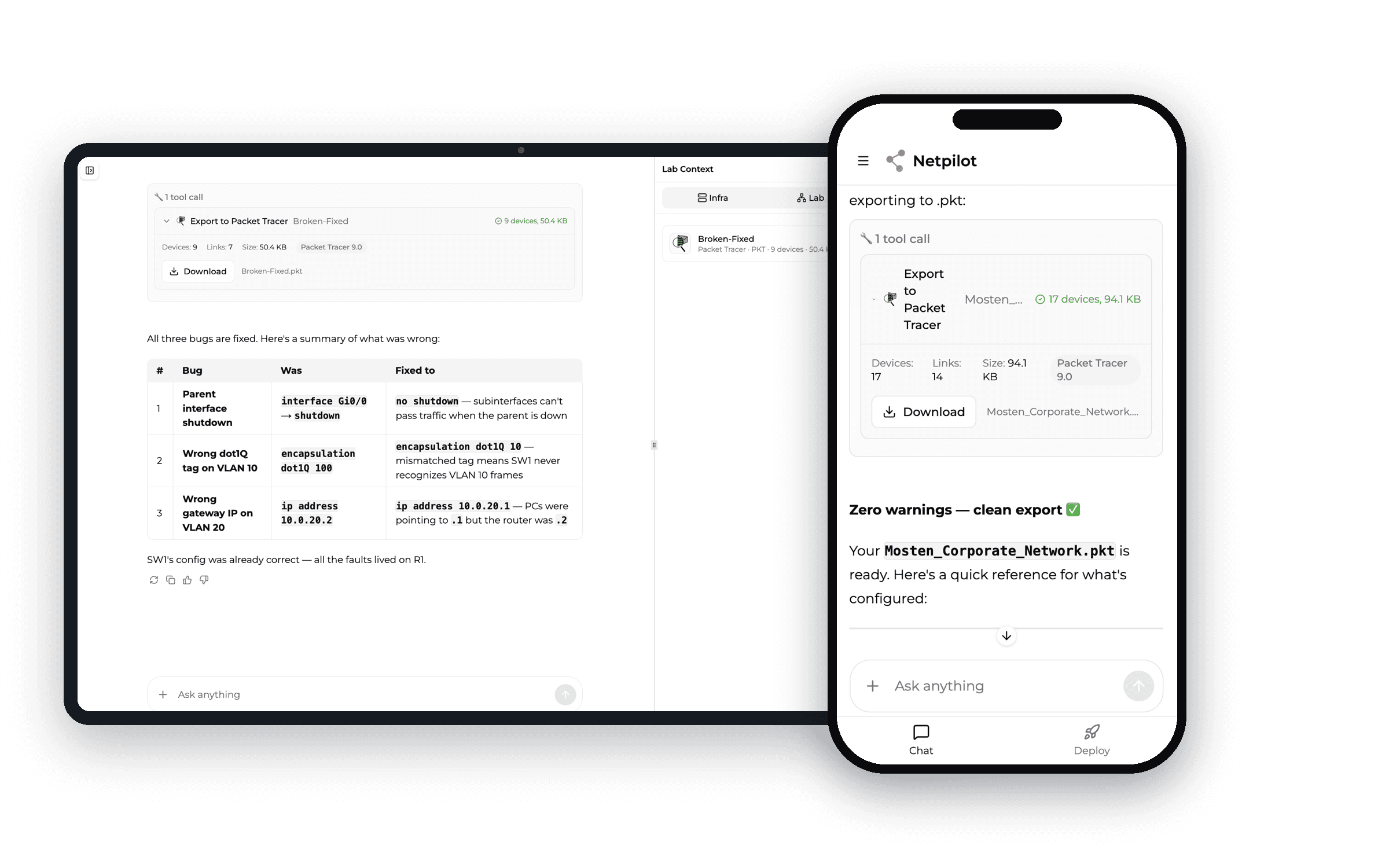
Describe a VoIP lab, get a configured .pkt — CME, IP phones, dial-peers — all from your browser. No Cisco Packet Tracer download required.
Trusted by network engineers worldwide
Why NetPilot, not just an AI chatbot
Three things a general chatbot structurally can't do for a Cisco Packet Tracer assignment.
.pkt round-trip — not just text
Import your broken .pkt; NetPilot diagnoses it, fixes the config, and hands you back a working .pkt to open and submit. General AI chatbots are text-only — they structurally can't read or write Packet Tracer's binary format.
Explains why, at your level
It walks you through the CCNA/CCNP/CCIE concept behind the fix in tutor voice — so you understand it and pass the exam, not just hand something in. The understanding is the deliverable; the working file is the proof.
Knows Packet Tracer's quirks
Tested against hundreds of Packet Tracer scenarios — it knows which commands the simulator won't run, which OSPF LSA types are missing, and why DHCP behaves differently. ChatGPT was trained on real IOS docs, not the simulator.
Build and fix Cisco Packet Tracer VoIP labs — from any browser
Generate a configured VoIP .pkt from a prompt, repair a broken one with AI, and do it all without installing anything.
Build a VoIP topology from a prompt
Describe it — "a router running CME, a PoE switch, and two IP phones that can call each other" — and NetPilot hands you a fully configured .pkt with the voice VLAN, DHCP option 150, telephony-service, and ephone-dn set up.
Fix a broken VoIP lab
Import a .pkt where phones won't register — NetPilot finds the PoE, DHCP option 150, or dial-peer mismatch, fixes the configuration, explains the reason in plain English, and exports a working .pkt back to you.
Runs on any device, nothing to install
No 870 MB download, no NetAcad account, no disk space. Chromebook, tablet, library PC, or a locked-down school laptop — if it has a browser, you can build the VoIP lab.
Every Cisco Packet Tracer VoIP Lab — Online
From a single-site CME to two-site dial-peers — describe any VoIP lab and get a working .pkt file, or practice on real CLIs.
Single-Site CME Lab
Describe a router running Call Manager Express, a PoE switch, and two or three IP phones that register and call each other — get a working .pkt with telephony-service, ephone-dn, and DHCP option 150 set up.
Get This LabTwo-Site Dial-Peer Lab
Phones behind two CME routers calling across a WAN link. NetPilot configures the VoIP dial-peers, destination-patterns, and session targets so site A can call site B — and explains the pattern matching.
Get This LabVoice VLAN + DHCP Option 150
Separate voice and data on a voice VLAN, hand phones an address with DHCP option 150, and watch them find the call server. The two settings most VoIP labs get wrong, configured and explained.
Get This LabIP Phone Registration
Get 7960 IP phones to power on (PoE), pull an address, and register to CME. NetPilot wires the power and config so you can focus on understanding the registration flow.
Get This LabQoS for Voice
Prioritise voice traffic so calls stay clear under load — mark and queue voice packets. AI configures the QoS policy and explains what each class actually protects.
Get This LabTroubleshoot a VoIP Lab
No dial tone, phone won't register, or calls between sites fail — NetPilot imports the broken .pkt, finds the PoE / option-150 / dial-peer break, and walks you through the fix.
Get This LabThree Ways to Build a Cisco Packet Tracer VoIP Lab
Packet Tracer is where your lab runs. The difference is how you get it built — by hand, with ChatGPT, or with NetPilot.
Doing your Cisco Packet Tracer lab: the realistic options
Cisco Packet Tracer is where you open and submit your file — the companion, not a competitor.
Frequently Asked Questions
Common questions about VoIP labs in Cisco Packet Tracer
VoIP Tutorials & Troubleshooting
How to Configure VoIP (CME & Dial-Peers)
Step-by-step: voice VLAN, DHCP option 150, Call Manager Express, ephone-dn, and inter-site dial-peers.
Why Won't My IP Phones Register?
Fix phones that won't power on, won't get an IP, or won't register to CME — the common VoIP breaks.
Cisco Packet Tracer Online
Build any Packet Tracer lab in your browser — no download.
Explore Packet Tracer Resources
Cisco Packet Tracer Download
Download PT for Windows, Mac & Linux — or skip the 870MB install and build labs in your browser.
Cisco Packet Tracer Online
Build any Packet Tracer lab in your browser — no download.
Cisco Packet Tracer AI Tutor
Paste your assignment — get step-by-step commands, the why explained, and .pkt export.
Cisco Packet Tracer Projects
Describe an office, hospital, or campus network — get a working .pkt project with the design explained.
Cisco Packet Tracer Wireless
Build WRT300N, WLAN, and WLC wireless labs in your browser — configured and explained.
Cisco Packet Tracer IoT
Build smart home & IoT labs — Home Gateway, sensors, and conditions — in your browser.
Packet Tracer vs Real IOS
Every command and protocol where the simulator differs from real IOS.
Packet Tracer Alternative
Outgrowing Cisco Packet Tracer? See why students switch to AI-powered labs.
Free CCNA Practice Lab
Practice with AI-powered labs covering OSPF, EIGRP, VLANs, and STP.
Free CCNP Practice Lab
Level up to CCNP ENCOR & ENARSI with AI-generated lab scenarios.
CCIE Practice Lab
Build enterprise-scale CCIE topologies on real Cisco IOL CLIs in minutes.
Build Your VoIP Lab. Understand Every Step.
Describe a CME, IP phone, or dial-peer lab and get a fully configured .pkt in your browser — with the configuration explained, free.